News

Strawberry Lane

This past spring, before I came to RCS, I became interested in learning more American folk songs. I found a book containing a collection of American folk tunes entitled “The Alan Lomax Collection”. I went through the book and found some of my favorites.

One of the songs was called “Strawberry Lane” which is derived from the old English ballad of The Elfin Knight. “This song may well have been composed by women (for there were many female bards in early Britain) at a time when women more openly expressed their feelings. ” Alan Lomax

“The riddling contest between mortal and demon is a folk motif older than the Sphinx, and this part of the ballad still survives, even though the girl and her elfin lover were long censored out of the story. Its ancient, half-understood symbols pleased the women and girls of Britain and the American frontier, and the song traveled all the way to the Pacific coast. In the old days, a girl who made a shirt for a man meant to marry him.” – Lomax

I made a very quick recording of the song which you can listen to here.

I also found another recording of the song on YouTube which you could also check out.

I’m hoping to find more American folk songs and learn more about the different styles of folk music in America.

IMG_9116

Lone Green Valley

Over the summer I learned a few tunes from Alan Lomax’s collection of American folk songs. One of the more darker songs was a murder ballad called, “Lone Green Valley”.

I uploaded a simple recording of the song to my SoundCloud which can be found here.

The story behind this song has a dark and mysterious origin. “A woman in Mississippi in 1929 confessed to a murder by mailing the Governor of the State an adaptation of this song.” – Alan Lomax

The song also inspired a very famous piece of American Regionalist art. “The Ballad of the Jealous Lover of Lone Green Valley” was painted by Thomas Hart Benton in 1934 and it depicts the murder of the woman in the song.

thomas-hart-benton-lone-green-valley.jpg

I found a recording of “Lone Green Valley” sung by Vernon Delhart, an American country singer and songwriter, on YouTube which was recorded in 1929.

I find that many American folk songs have very dark lyrics yet the tune and chords remain upbeat. In my version of the song, I changed the chords slightly to emphasize the sadness and pointlessness of the woman’s death.

“One has constantly to remind oneself of the extremes of repressiveness of the age that revelled in these bloody songs – an epoch when a leg was called a limb, even by country people- and age when women were bundled up in forty petticoats and shielded by bustles – a time when no respectable woman could speak to a stranger in the street without a breath of scandal falling upon her – a century when there were only two paths open to women, one leading to the red lights, the other toward the altar. For the people of this period, the folk ballads had a special significance; they stood for pleasure and for excitement, which the age had subordinated to work and to respectability.” – Burl Ives.

IMG_9117

The First Tune

The first tune I ever wrote on the harp was about three years ago. I had been playing the harp for a little over a year at the time when I was ‘hit’ by inspiration. I called the tune “A Different Day” and it all stemmed from a simple random gesture. Surprisingly, I remember the day very clearly. It was autumn and the leaves had turned to gold, orange, and red. I was out on a walk with my camera trying to capture some photos for a photography class. On my way back, I walked past three girls standing on the corner opposite my house trying to flag down the passing-by cars. I asked them what they were doing and they told me they were trying to raise money for the local high school by taking in old clothes and shoes. The only problem was, they didn’t have a sign and few cars were stopping. I wished them good luck and crossed the street back to my house. Realizing I had some poster board in the basement, I grabbed some markers and the posterboard and headed back outside. We spent about twenty minutes making the sign and it turns out that I had taken ballet classes with one of the girls years ago and she knew my name.

It was such a random thing for me to go out there and make a sign with them but it was so unexpected and it made my day. I knew I wanted to remember the spontaneity of the moment and the ‘different day’ I had.

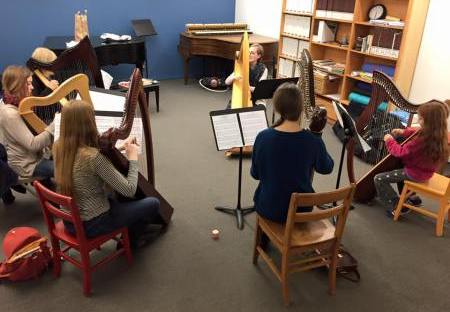
I wrote the tune in about twenty minutes and it went through several changes over the course of the week. I ended up arranging it for a group of harps which I taught at a CT Harp Ensemble class. You can listen to the recording of us playing it here.

The tune starts in C minor and then moves to Eb Major.  This transition was to represent the shift that occurred in my day. You can view the score for “A Different Day” here: A Different Day Harp Group.

When I look back on the tune I can see now how much I have learned and grown as a musician.

I used to think that I had to wait for inspiration to come to me. Now I know that I have to sit down and work on composing something rather than waiting for the tune to pop into my head. While every now and again I do get inspiration for tunes, the process of composing is long and sometimes tedious, yet I always learn something new and surprising.


Tradition

As a young child, I would have associated the word ‘Tradition’ with Saturday morning big breakfasts. My dad and I would put on our aprons and our chef hats and cook hash browns, fry bacon, scramble or poach eggs, grill french toast, and make pancakes or waffles. We would sit around the kitchen table and talk while we all shared a meal. It was a tradition to make my grandma’s dumpling soup with my mom using the leftover turkey from Thanksgiving dinner. I remember being young and too short to see into the huge pot of soup boiling on the stove. I was always so impatient to taste our creation. Every year on my birthday my grandparents call and sing happy birthday to me over the phone. Their two-part harmonies are a birthday tradition for everyone in the family. I also associate the word ‘Tradition’ with the classic song, “Tradition” from a favorite family musical called “Fiddler on the Roof.” Now, after being introduced to Traditional music and the culture surrounding it, the word has multiple meanings to me.

I was first introduced to Traditional music by my harp teacher, Haley Hewitt. The first tune she taught me was a Scottish tune, and I fell in love with the sound of Traditional music. I felt as if it was so natural to listen to and I could hear the richness of its past in the notes. The styles of Traditional music intrigued me, and I was immediately hooked.

Haley encouraged me to attend the Ohio Scottish Arts School, (OSAS). I came to OSAS knowing two Scottish tunes and left having learned so many tunes, and more about the history surrounding the music of Scotland.

I began competing in Scottish harp competitions and attending OSAS every summer. I ventured out to sessions with the clarsach and became part of a Celtic trio.

As I prepared to audition to the RCS, I decided it would be amusing to get my DNA tested. I was curious to see if I had any Scottish blood. Relatives had told me about my heritage, but no one had the same information. I spit in a tube, popped it in the post and a month later I got my results.

I found out that 59% of my DNA came from Great Britain. That includes DNA from England, Scotland, and Wales. Knowing that was my heritage I got so much more excited about discovering and learning more about Traditional music. The DNA test also revealed that I was 7% European Jewish. The Jewish DNA showed that my ancestors had come from Poland, Belarus, Ukraine, Russia, Hungary, and Israel.

I had known about my Jewish heritage yet finding out that I truly had come from that cultural background spiked my curiosity into exploring the traditions of my ancestors and currently practicing Jewish relatives.
I tried making matza ball soup and learning a little more about Jewish holidays. I would love to learn more about traditional Jewish music and the history surrounding it.
Growing up in America and not having been immersed in the Scottish and broader Celtic traditions I know that I still have so much to learn. I think that the word ‘Tradition’ for me means respecting the past and learning from our ancestors. Tradition is so important because our present will someday become the traditions of the future generations. We need our past to learn and grow in our future.

Influences

I was born and grew up in the suburbs of Seattle, Washington in a town called Bellevue. It was very diverse and filled with hipsters, coffee drinkers, and moms in yoga pants.

Some of the early influencers of my music was Seattle’s jazz radio station, 98.9 that was always playing on our car’s radio. I grew up listening to jazz and also really loved Frank Sinatra, Ella Fitzgerald, Louis Armstrong, and Henry Mancini.

As a kid I loved to watch old movies with Doris Day singing or Bing Crosby crooning. I would stand in front of the television and sing. I remember as a child trying so hard to imitate the voices of my idols.

I didn’t realize how ingrained jazz was in my music until I began arranging trad tunes. The free form and easy listening style of jazz was something I unknowingly imitated.

Throughout the numerous classes I’ve had on tradition in the past month, I have begun to remember and recognize the traditions and musical styles that have formed me to be the musician and person that I am today. The fact that I am so far from home and the traditions that I grew up with has allowed me to look at my childhood and the beginnings of my musical journey with a new and unique point of view.